

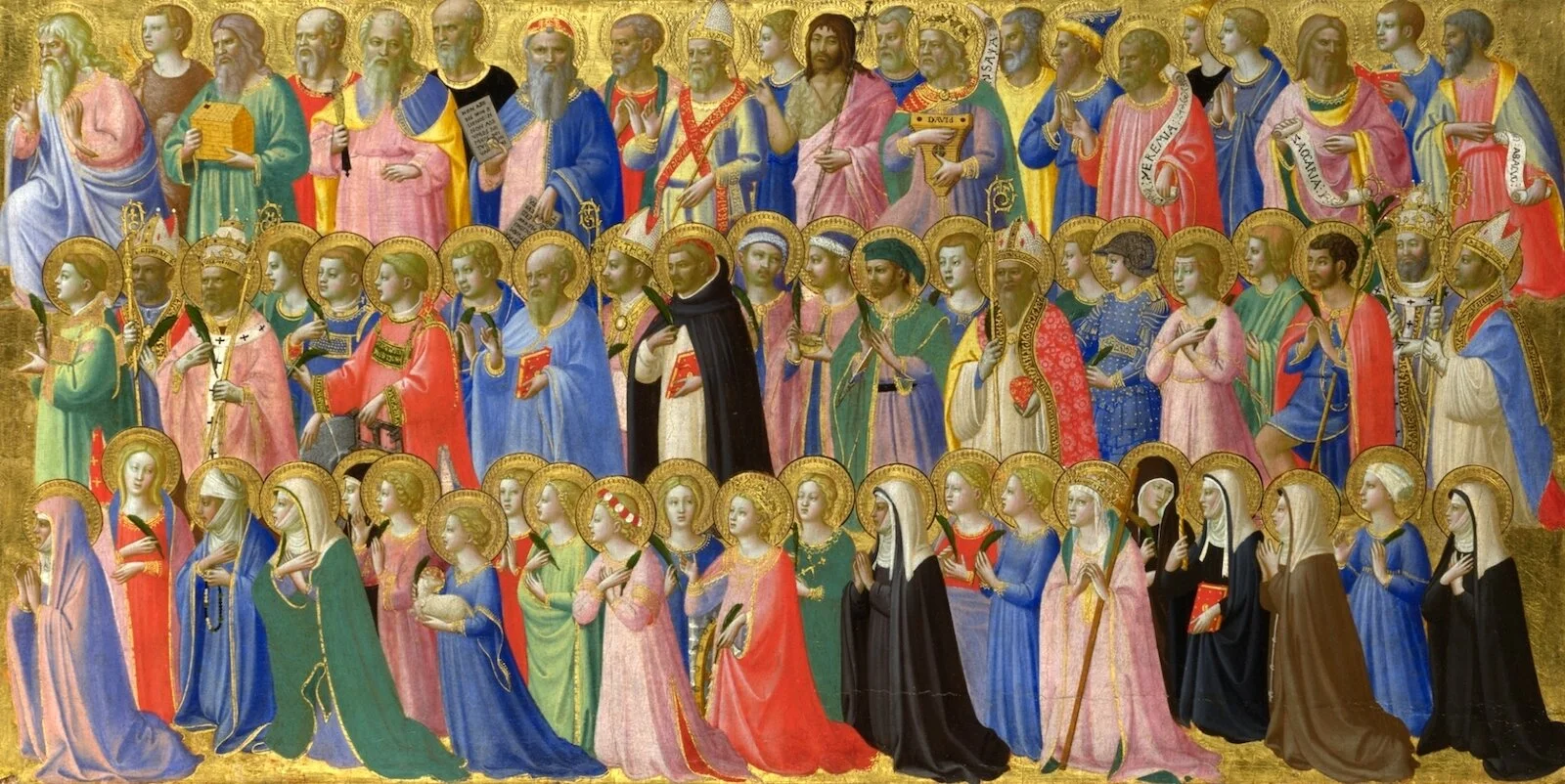
This Sunday, November 1, is All Saints’ Day. All Saints’ Day is a lost holiday for most of us, partially because its purpose and theology it is far less clear than most Christian holidays, partially because of the Protestant rejection of the particular Roman Catholic doctrine of the saints, and partially because it is overshadowed by Halloween in American culture.
But All Saints’ Day is a holiday that should be recovered! It would serve the church well to set aside a day each year to remember those who have gone before us in the faith.
First, we need to remember when we are tempted and discouraged that we are actually surrounded by a “great cloud of witnesses” (Heb. 12:1). It is easy to think that our struggles are unique, but we can be strengthened when we remember that those who have gone before have faced similar trials and been strengthened by the grace of God in the midst of those trials. Second, we need to remember the specific people God has used in past generations to bring us to a point of salvation. Paul reminds Timothy of the faith of his grandmother and mother, a faith that is now alive in Timothy (II Tim. 1:5). Each of us has spiritual ancestors—mothers and fathers, grandmothers and grandfathers—who have lived with faith, and given the faith to us. We are heirs of the inheritance that these saints have left for our families. Third, we need to remember that there is only one body of Christ and one Church (Eph. 4:4-6), and those who have gone before are our brothers and sisters, equal members of the body of Christ with us. We are united with them just as we are with those who are still alive on this earth. And last, remembering the saints reminds us of the resurrection. Our hope is grounded in the fact that, one day, “we shall be changed…and raised imperishable” (I Cor. 15:50-58). Our hope is not in perfecting this body, this life, this world—it is instead in the resurrection and new creation.
Use this Sunday to remember the saints who have gone before you. Tell your children the stories of your grandparents. Read a biography of a great missionary. Thank God for the faithful who have brought you to a place of salvation. And rest assured that, just as God has preserved them for the resurrection, you also will be brought in splendor into the new creation.
Steven+
Isaiah 41

Isaiah 41 begins with a courtroom scene that develops over a number of chapters, a trial where God is both judge and prosecutor. The nations are the audience, watching God prove his case. The idols of the world are defendants, prosecuted by God. Yet there is also a special group in the audience; the trial is for their benefit. Is it the jury? The victim?
The special member of the audience is Israel himself. God questions and accuses the idols in Israel’s presence, challenging them to predict the future or explain the past. But he also addresses Israel directly, as a prosecutor might address a jury. Israel needs to listen, because they have been humbled and broken by pagan nations, and are fearful. Where has the God of Israel been?
Yet the Lord answers their fears. He says to them, “Fear not, for I am with you; be not dismayed, for I am your God; I will strengthen you, I will help you, I will uphold you with my righteous right hand.” Over and over he tells them, “Fear not!” He has not abandoned his people. He will be their redeemer and rescue them from slavery and exile.
The world is chaotic and full of danger. Yet God proves that the idols of men are nothing. They are merely objects, things people build to protect themselves. They have no power. They cannot do anything, they do not know the past, and they cannot tell the future. God alone can do these things; he alone is Lord over history, and the world is in his hands.
We, like Israel, live in a chaotic and turbulent world. Like Israel we are tempted to trust in what we build and accomplish. Through our efforts we strive to create something that will protect us. Yet God alone is King over history—the idols we create totter and fall. He is not distant; he is both “the first” and present “with the last.” He remembers the poor and needy, thus we can take courage in the Redeemer. We need not fear the idols of the nations, nor should we create our own, because God alone knows the future.
-A Prayer from Isaiah 41-
You, O Lord our God, hold us by the right hand; it is you who says to us, “Fear not, for I am the one who helps you!” You are the Holy One of Israel, yet also our Redeemer. You alone know the future, and nothing happens outside your providence. May we live in these turbulent times without fear, trusting that you are Lord over history.
Steven+
A Reflection on Psalm 80

Give ear, O Shepherd of Israel,
you who lead Joseph like a flock!
You who are enthroned upon the cherubim, shine forth.
Before Ephraim and Benjamin and Manasseh,
stir up your might and come to save us!
Psalm 80 laments the exile of the northern tribes, those called “Israel” or “Ephraim” after the split of the kingdom under Rehoboam the son of Solomon. It may have been composed by refugees from Israel, but it also may have been composed, and was certainly used in worship, by the southern tribes, “Judah.” It is a beautiful affirmation of the unity of God’s people, naming Benjamin (one of the southern tribes) between Ephraim and Manasseh (two of the northern tribes).
Restore us, O God;
Let your face shine, that we may be saved!
“Turn us again!” As Steven mentioned in his sermon on Sunday, that is the more literal rendering of the Hebrew phrase here. When the kingdom split, becoming North (Israel) and South (Judah), the first king of Israel set up golden calves in Israel as a substitute for the temple at Jerusalem because he was afraid he would lose his power over the people if they went into Judah to sacrifice and participate in the feast days given in the law of Moses. Yet our God is enthroned upon the cherubim—in his heavenly courts, of course, but the physical symbol and copy and his only authorized place of worship was in the temple, where his “Holy Seat” was on the ark of the covenant, between the two cherubim of gold set there. In this haunting refrain, Judah is included in this call to repentance, to turn again to the one true God and to his ordered worship because that is where he shines forth!
You brought a vine out of Egypt;
you drove out the nations and planted it.
The picture of God’s people as his planting, the vine in his vineyard, is the imagery of the rest of this psalm, as well as in this past Sunday’s readings from Isaiah 5 and Matthew 21. In John 15 Jesus takes this imagery on himself, calling himself the true vine and the vinedresser his Father. Which is to say, Jesus is united Israel--united not only North and South, but as David prays for his own heart in Psalm 86:11, united to fear God’s name. To Jesus, as it was once to the temple in Jerusalem, is now where we all must turn, must ask the Father to turn us, that his Son’s face may shine upon us! As it says in To Be a Christian (the new Anglican catechism):
What does is mean for you to repent?
To repent means that I have a change of heart, turning from sinfully serving myself to serving God as I follow Jesus Christ. I need God’s help to make this change.
Turn us again, God of our salvation! Restore us again in your unfailing love.
- Rebekah