

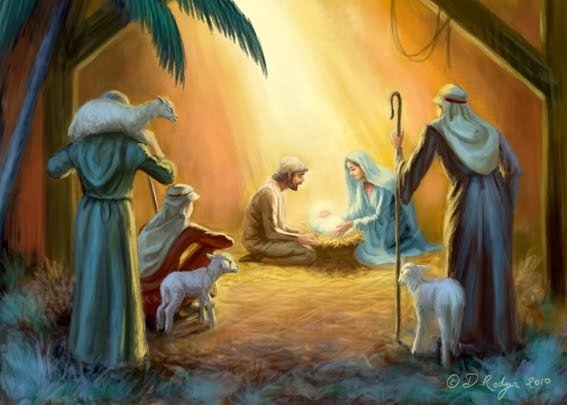
On the third Sunday of Advent, we light a pink candle, which represents joy. On the official “Breedlove Advent wreath,” the joy of the third candle is connected to the shepherds, because it was to the shepherds that the angel declared, “I bring you good news of great joy!”
We know the end of the statement; we know why the news was a declaration of joy. “For unto you is born this day in the city of David a Savior, who is the Messiah, the Lord.” But perhaps these words are so familiar to us that we have lost sight of the joy. We frequently need to slow down, so that we can remember again and rejoice.
“Unto you.” From the beginning it is explicit—God is not just for those who deserve it, for some more worthy people. The Messiah is for you, his life is on your behalf. The poor shepherds were likely stunned, just as we should be, “For me? He is actually for me?”
“Is born this day in the city of David.” This is not a pleasant fiction, a story we tell to feel better. On a specific day, at a particular moment in history, in a particular place, the Messiah was actually born. He lay in his mother’s arms as real as every other baby, needing to be cleaned and fed and soothed. His tiny limbs and heart would bear the hatred and sin of the world, but he was real—God actually in the flesh, vulnerable and small.
“A Savior.” We spend our energy in a frantic attempt to secure life, to save ourselves. Yet every day is a testimony to the fact that we cannot ever do enough. We did not author life, and it is not under our control. We need a Savior, and it is a Savior who was born for us.
“Who is the Messiah, the Lord.” The shepherds didn’t need to be told why the birth of the Messiah was an occasion for joy! The arrival of the anointed one, the promised one, who would usher in the kingdom of God, reign from the throne of David, and restore God’s people was an obvious cause for celebration. But it should be staggering to us that we have been included in the kingdom of this anointed one. This Lord has said to us, “I want you to be one of my people, one of my restored ones.”
Every time Mary was confronted with the glory of her son, she treasured and pondered the moment in her heart. Do the same with the declaration of the angels and rejoice in what they said! “Unto you is born this day in the city of David a Savior, who is the Messiah, the Lord.”
Steven+
Advent Reflections: The Faith of Mary and Joseph

On the official “Breedlove Advent wreath,” the second candle symbolizes the faith of Mary and Joseph. The word “faith” likely brings to mind certain familiar phrases from the Bible, like “we walk by faith, not by sight” (II Cor. 5:7) or “faith is the assurance of things hoped for, the conviction of things not seen” (Heb. 11:1).
Familiar verses pose a certain danger. The beautiful verse, by virtue of its frequent use, becomes a platitude, easily ignored even as it sits in plain sight, inscribed on coffee cups and t-shirts. The answer to the familiar becoming a platitude is to slow down, and wrestle in the presence of God with his word. Is it really true that “whatever does not proceed from faith is sin” (Rom. 14:23)? How can I learn to do the dishes from a posture of faith?
Another danger—not about platitudes, but instead about our understanding of faith—exists in our culture. Many people, even many Christians, talk about faith as if faith itself (instead of what the faith is in), is what matters. For many, “having faith” is more or less synonymous with “I believe things will work.” “You just need to have faith” is a flimsy sentiment (things don’t always work out!), but the real danger is that the object of faith is mistaken. A desired outcome has taken the place of God.
Mary and Joseph help us here. Their faith is strong and beautiful, the sort of faith we all should have, but what makes it worth emulating isn’t primarily its strength. Instead, it is what they directed their faith towards. They were willing to step into a situation of incredible uncertainty, where being misunderstood and rejected by friends and family was highly likely. Mary would forever be branded as unfaithful to Joseph, and Joseph as weak. What is more, Simeon told Mary, “a sword will pierce through your own soul,” hardly words that might inspire the faith equals things will work out in the end posture of our culture.
Mary and Joseph’s faith should be emulated simply because it was directed towards God himself. They were willing to bank everything on him, regardless of the outcome of the situation. This is what Biblical faith is, not platitudinous optimism. When Hebrews 11 speaks of faith, it is describing people willing to take God at his word, whether they receive his promises in this life or the next. The “I am banking everything on him” posture is what pleases God (Heb. 11:6), even if it is coupled with “and I have no idea how or when this will work out.”
God’s word is trustworthy. His character is trustworthy. He is the only one faithful enough to warrant our faith. This week, as we await the celebration of Jesus’ first advent and the arrival of his second, bank on God. He will not fail you, even if you pass through a period of uncertainty like Mary and Joseph.
Steven+
Advent Reflections: Prophetic Hope

Each week in Advent has a particular theme attached to it, such as faith, hope, joy, or peace. Some traditions also associate these themes with characters and places in the Christmas story, such as the prophets or shepherds, Mary and Joseph, or the angels. Your Advent wreath may have these themes or characters engraved on it.
Although there isn’t a single, unified tradition (except that all traditions seem to place “joy” on the third week), I am going to follow the official “Breedlove Advent wreath” for the newsletter devotions over the next four weeks. We begin in week one, which on our wreath is labeled the “Prophet’s Candle, Symbolizing Hope.”
In the latter half of Isaiah, God frequently ridicules the false gods of the nations for not knowing the future while simultaneously reminding his own people that he does. As Is. 42:9 says (of future events), “before they spring forth I tell you of them.” It wasn’t that pagan deities didn’t have prophets. Prophecy and fortune-telling exist in many religions. But God’s point is clear—those gods and their prophets and fortune-tellers don’t know the future. They are blind, ignorant, and foolish.
For anyone who reads the Old Testament prophets or who listens to Jesus’ prophecies, it might seem strange that prophecy is associated in Advent with hope. After all, many of the prophecies focus on the judgment to come. The entire human race has been guilty of rejecting God and not worshiping him for millennia; we have been guilty of sinning against one another through violence and deceit since Cain and Abel; we have sinned sexually and through theft. We are guilty and deserve the judgment of God, and the prophets regularly remind us of this. Yet God’s descriptions of the future never end in judgment. Hope—restoration, redemption, healing—is always promised to those who will simply receive his word. God’s judgment has a limit, a boundary, an end; yet his mercy is infinite towards those who receive him.
We come face-to-face with the deepest hope of the prophets on Christmas morning—God in the flesh amongst his people. He did not come in judgment, but instead as “the sun of righteousness…with healing in its wings,” rising upon all those who fear the name of the Lord (Mal. 4:2). To fear the name of the Lord is the only prerequisite. We don’t need to be perfect, nor do we need to be guiltless. We don’t need to have our lives perfectly put together. Instead, everyone who approaches the Lord in reverence and humility will receive this healing. The message of the prophets is “darkness” and “calamity” (Is. 45:7) to those who reject it, but it is hope to those who receive it, a genuine and trustworthy hope that God will come near to us.
As you pray during this first week of Advent, remember the hope offered; remember God coming in the flesh with healing for you. Receive his word, and in humility worship him!
Steven+