

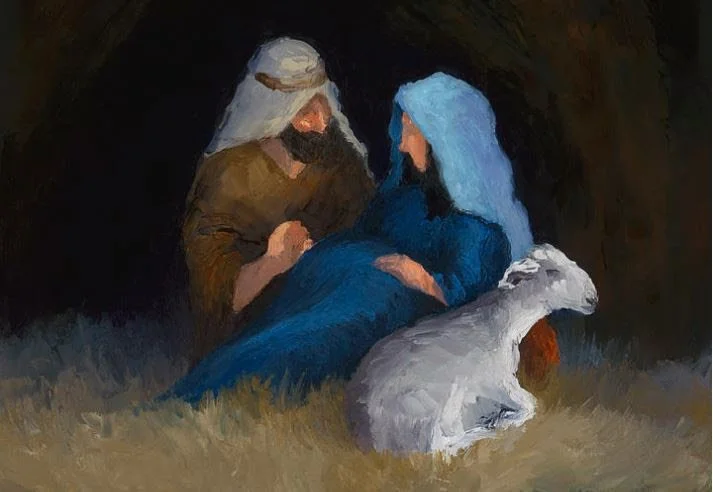
On Sunday, December 3, we enter Advent, the season of preparation that looks forward to the coming of Jesus. From a very early time in the Church’s history, Christians began to practice seasons of preparation before the great feasts. The thought was simple—we need to purposefully prepare ourselves so that we are ready for an encounter with Jesus. The two seasons of preparation (Advent and Lent) look forward to the two great feasts (Christmas and Easter). In both instances, the Church taught that preparing ourselves meant fasting and prayer.
The fast of Advent is not a deep or severe fast. It is not driven by penitence, but instead by patience, hope, and expectation. It is like waiting for a wedding banquet, which we would hardly prepare for by eating too much cheap food. Instead, we wait in modest fasting, with joy and expectation, because a feast is coming. The certainty of Christmas offers us the ability to wait in patience and hope.
But it is the return of Christ, not Christmas, that we are ultimately waiting for in Advent. The first coming is proof that the second will also arrive, and our joyful waiting for Christmas should prepare us for Christ’s return. More than anything, this is the season of the year when we should cultivate a patient longing and hope for the second coming of Christ.
Prayer in Advent should be marked by this expectation. Every prayer should be grounded in the fact that Christ will come again and restore all things. Every reading should be considered from the standpoint, “What will this mean when Christ returns?” The season offers us a particular form of discipleship—discipleship in waiting. It should be the season where, even as we learn hopeful patience, our hearts fill with the prayer, “Lord, I long for your return! Please prepare me to celebrate your arrival!”
In order to help the people of Incarnation prepare for the coming of Christ, we have put together a devotional guide. A digital copy is available here, and physical copies will be at church on Sunday. Feel free to share them with friends and family!
Steven+
Angel Tree

This Christmas, we will be giving gifts through Prison Fellowship’s Angel Tree program to children who are separated from a parent because of incarceration. The gifts are purchased by people in the church and are given to the children on behalf of the incarcerated parent. This is a great opportunity to show the love of Christ to families who are affected by incarceration.
On November 26, there will be a Christmas tree at church with “angel tags” on it that give information about the children. Everyone at Incarnation who wants to participate should take a tag from the tree and buy the appropriate gifts, based on the information on the tag. (We would like each child to receive two gifts, one worth approximately $5-10 and one worth approximately $25-40.) After buying the gifts, you will simply wrap them, fix the “angel tag” to them, write the gift code inconspicuously on the corner of the package (in case the tag falls off in transit), and return them to church no later than Sunday, December 17 (you can return them earlier!).
We also need volunteers to help deliver the gifts the week before Christmas (December 18-22). If you would like to deliver gifts to a family, please let me know no later than Friday, December 15.
Katherine
Christ the King

The last Sunday of Pentecost Season is Christ the King Sunday (Nov. 26 this year). Pentecost Season, which begins with the gift of the Spirit for the sake of witnessing to Jesus the Messiah (Acts 1:8), ends with a Sunday dedicated to declaring that Jesus the Messiah is the King of the cosmos. He is King of all spiritual beings, all earthly and heavenly powers, and all of humanity. This is our witness: Jesus the Messiah is King.
Christ the King Sunday thus looks backwards. It reminds us of the point of the Pentecost—the Spirit was given that we would tell the world about Jesus, and he is King. But it also looks forward! As the last Sunday before Advent, it prepares us for Advent. It reminds us that a little baby, born in poverty and humility in a small stable to an undoubtedly terrified young woman, is our King. Advent teaches us to long for the coming of Jesus, and Christ the King Sunday makes certain that we remember who it is we are waiting for. In other words, looking backwards, it reminds us of our call to witness, and looking forward, it reminds us of our hope.
The Gospel readings in the weeks leading up to and including Christ the King Sunday shift our perspective from the here-and-now to this One who is to come. This year, the readings in the final weeks of Pentecost Season are from Matthew 25, where the One who is to come is described as bridegroom, master, and judge. Each section of this chapter cries out, “Be ready! He is coming!”
Being ready is different in each section of Matthew 25. Waiting for the bridegroom (25:1-13) means being watchful and having our lamps full of oil. Oil—the symbol of the anointing of the Spirit—indicates that we aren’t ready for the coming Messiah if we aren’t praying for and attentive to the gift of the Spirit. Waiting for the master (25:14-30) means using our resources and talents with the awareness that they are actually the master’s. They are given to us while he is away, but we will answer to him for what we do with them, and he expects us to use them the way he would. And waiting for the judge (25:31-46) means taking care of the poorest peoples of the world—as if each one is Jesus himself—while we wait. This King cares that the hungry, the immigrant, the naked, the sick, and the prisoner are visited, cared for, and invited into his kingdom by his subjects.
Each of us probably needs to be jolted out of the here-and-now in different ways. Life is busy and overwhelming. It can be easy to live with our sights set no further than the next Saturday. But as we approach Christ the King Sunday, let the Gospel readings wake you up to remember what it means to wait for our coming King.
In the name of Jesus the Messiah, the coming King,
Steven+