Isaiah 43

5728a6f8-d73a-49bd-97f3-fd016661364a.jpg

1 But now thus says the Lord,
he who created you, O Jacob,
he who formed you, O Israel:
“Fear not, for I have redeemed you;
I have called you by name, you are mine.
2 When you pass through the waters, I will be with you;
and through the rivers, they shall not overwhelm you;
when you walk through fire you shall not be burned,
and the flame shall not consume you.
3 For I am the Lord your God,
the Holy One of Israel, your Savior.
I give Egypt as your ransom,
Cush and Seba in exchange for you.
4 Because you are precious in my eyes,
and honored, and I love you,
I give men in return for you,
peoples in exchange for your life.
5 Fear not, for I am with you;
I will bring your offspring from the east,
and from the west I will gather you.
6 I will say to the north, Give up,
and to the south, Do not withhold;
bring my sons from afar
and my daughters from the end of the earth,
7 everyone who is called by my name,
whom I created for my glory,
whom I formed and made.”

There are moments in the Bible when we see that God’s concerns are not always the same as ours. We want to be free of pain and difficulty, but God cares more that our hearts long for his presence and trust him. God allowed his people to be plundered, trapped and hidden in prisons because they rejected him. Judah had sinned against God, and refused to walk in his ways, and so he gave them to their enemies. They longed to be free of the exile, but God longed more for them to be faithful to him.

But even in delivering them to suffering and exile, God did not abandon them. His love for them was far too strong. He promised redemption—not a superficial sentiment, but instead actual redemption, where the north and the south, the east and the west released the prisoners to come home and rebuild their families and lives. God’s chastisement was for a season but was not abandonment. It was because of his love that he purged their idolatry, because idolatry brings death.

Yet even in the dark moment, when God’s people were driven from home in suffering, God was not far off. When Daniel’s three friends were cast into the fiery furnace in Babylon, God walked there with them. Ezekiel, while in the land of Babylon, saw the throne of God on wheels, carried by angels so that God would be with the exiles where they were. They were being disciplined, but God was suffering their exile with them! And in Isaiah 43, we hear God say to those in exile, “When you pass through the waters, I will be with you.”

I will be with you.

I will be with you in your suffering. I will be with you in your grief. I will be with you in your exhaustion. And even if I have to discipline you, to purge you of idolatry, I will be with you in the discipline.

As you pray today, rejoice that the Lord is with you, no matter where you are or what you are enduring. Pray for those Christians who are blind to the presence of God in their lives. Pray for those who have not yet met God and do not know that he would be with them.

-A Prayer from Isaiah 43-
You, O Lord, have created and formed us. You have redeemed us, and so we need not fear. You have walked through the waters with us; indeed, you have walked through the waters of death for us. The flames will not destroy us, for we are called by your name! You are the Holy One of Israel, our Savior!

Steven+

Scripture Reflections

Rev7.9-10 850W.jpg

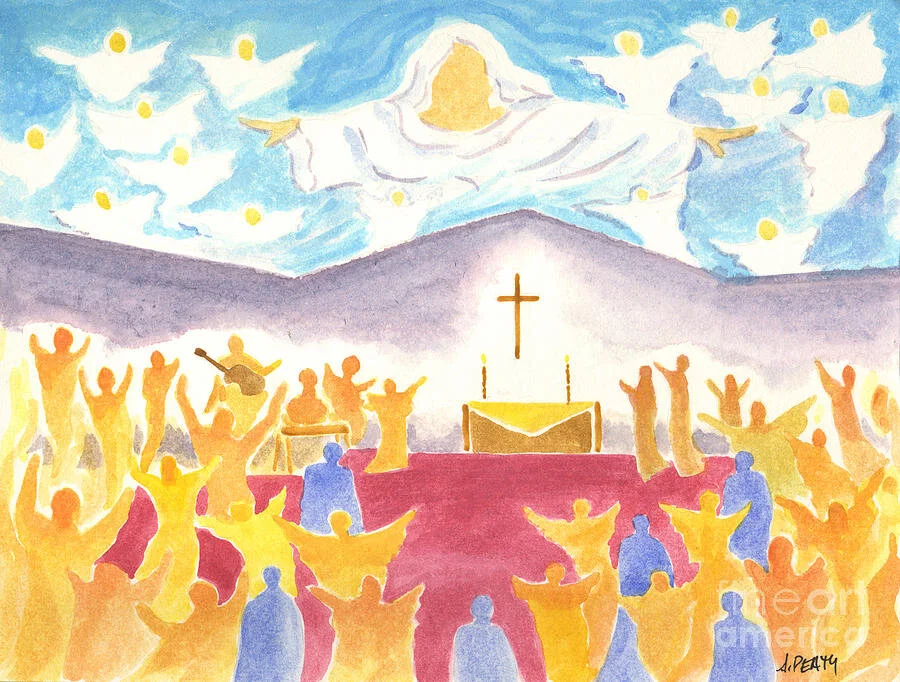
After this I looked, and behold, a great multitude that no one could number, from every nation, from all tribes and peoples and languages, standing before the throne and before the Lamb, clothed in white robes, with palm branches in their hands, and crying out with a loud voice, “Salvation belongs to our God who sits on the throne, and to the Lamb!” (Rev. 7:9-10)

For two Sundays in a row we have heard this passage, yet it was not until today, when I was rereading it, that I finally paused long enough for the cry of the multitude to sink in. Perhaps it was the Spirit of God, but my eyes landed on the song of the multitude, and suddenly my heart heard them. Saints from every tribe, tongue, and nation clustering around the heavenly throne, shouting.

“Salvation belongs to God! And it belongs to the Lamb of God!”

Of course, we acknowledge the same thing—salvation does belong to God. Yet we aren’t shouting it, delighting to declare it to one another, or singing it all the time. None of us have likely shouted this at anyone recently. We acknowledge it, but then get back to the business of life.

But the saints around the throne don’t let the moment pass so quickly. They have arrived on the other side, they have come through the tribulation, their sins have been washed away (14), and now they see the salvation with their own eyes. They are safe, in the presence of the Lamb, and so they cry out with a loud voice, “Salvation is yours! You have it in your hands! You alone can save! You have done it!”

We acknowledge that salvation belongs to God, but because we have not yet seen it in many areas of our life—struggles in our families and with personal sin, bodies weary from the effects of the fall, a nation and culture in the throes of turmoil—our voices sometimes falter. Do we really believe that God has salvation in his hands? Salvation from our weariness, our discouragement, our shame, our fear? Do we really believe that we too, one day, will emerge on the other side of the tribulation and get the chance to cluster around the throne, gaze at the Lamb, and shout with the crowd before the Father?

It is hard to keep believing many days. It is hard to believe that salvation is real, that the Lamb really has conquered, and that God the Father truly will preserve us to the end. Listen to the testimony of those who have gone before; listen to the saints who have already emerged from the tribulation, and let their cry bring strength to your soul!

“Salvation belongs to God! And it belongs to the Lamb of God!”

Steven+

Scripture Reflections

worship-god-in-spirit-and-truth-audrey-peaty.jpg

The book of Revelation gives us the heavenly perspective on Jesus’ ascension to the throne, following his death and resurrection. In Revelation 7:9-17, one of our readings from this past Sunday, John sees the response of the saints in glory to Jesus’ appearance in his Father’s throne room: waving palm branches and praising God! Psalm 149, which we also read this past Sunday, seems to have been written for just such an occasion—"a new song” for a new age, music and dancing to celebrate a great victory, and eager anticipation of the Lord’s reign extending over all nations, peoples, and kings. In this psalm we find instruction for how we are to live as saints now, as we look forward to joining in celebration with those who have gone before us. The instructions of the second half of the psalm can be confusing and even off-putting at first glance, though:

Let the high praises of God be in their throats
and two-edged swords in their hands,
to execute vengeance on the nations
and punishments on the peoples,
to bind their kings with chains
and their nobles with fetters of iron,
to execute on them the judgment written!
This is honor for all his godly ones.
Praise the LORD!

The nation of Israel did have a command from the Lord to bring his earthly judgment on particular peoples and kings in the land of Canaan, but the church has a different calling. As we read in Ephesians 6:12, “we do not wrestle against flesh and blood, but against the cosmic powers over this present darkness, against the spiritual forces of evil in the heavenly places.” Not only is our enemy different (spiritual forces instead of pagan nations), our weapon is different. The two-edged sword we are to wield is stronger than any other: “For the word of God is living and active, sharper than any two-edged sword, piercing to the division of soul and of spirit, of joints and of marrow, and discerning the thoughts and intentions of the heart.” Paul gives us a beautiful picture of saints rightly wielding the weapons given to them in 1 Corinthians 14:24-25: “But if all prophesy [speak the word of God], and an unbeliever or outsider enters, he is convicted by all, he is called to account by all, the secrets of his heart are disclosed, and so, falling on his face he will worship God and declare that God is really among you.” But we will never be able to bring others to repentance and worship if we do not firstly and continually ask our King to use his sword on us, joining with David in the words of Psalm 139:23-24:

Search me, O God, and know my heart!
Try me and know my thoughts!
And see if there be any grievous way in me,
and lead me in the way everlasting!

Like our King, we must trample over death by death, daily taking up our cross to follow him. So may it one day be said of us as it said of the saints in glory (Revelation 12:11), “And they have conquered him [Satan] by the blood of the Lamb and by the word of their testimony, for they loved not their lives even unto death.”

- Rebekah